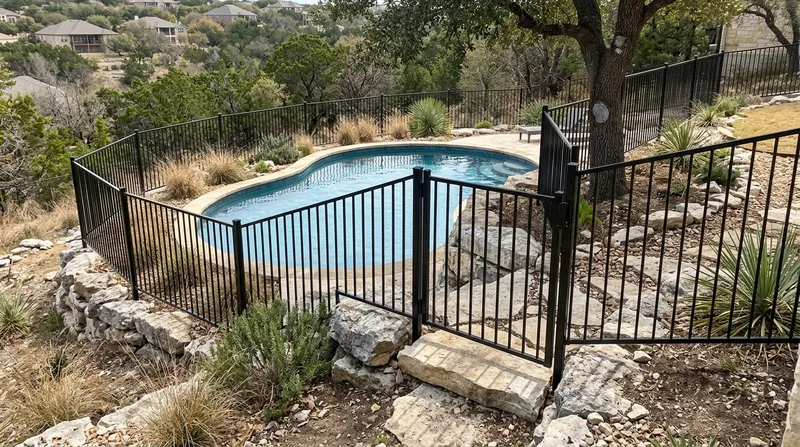




A pool fence installation in Austin protects young children and meets state law on every property where a pool sits on clay or rock. Austin's expansive clay soil and high water table demand deep post setting and proper drainage to keep your barrier stable through wet seasons and the summer heat cycles that heave shallow footings. Whether you're installing a new fence around a recently completed pool or upgrading an existing barrier that no longer meets current code, we size gaps, set latch heights, and choose materials that hold up to the humidity and sun exposure that define Austin poolside life. Our crew has installed hundreds of compliant barriers across Austin, Round Rock, Cedar Park, and surrounding areas since 2015, and we work from your local building department's code and your HOA rules if one applies to your property.
Why Pool Barrier Code Matters: Safety and Compliance in Austin
Texas pool barrier law exists to prevent child drowning. Your pool fence must meet the code that applies at your address, which varies by jurisdiction and is enforced by your local building department or code official. The barrier must be at least 4 feet tall, have gaps no larger than 4 inches between pickets or mesh, and feature a self-closing, self-latching gate that opens away from the pool. Posts must be set deep enough to resist heaving on clay soil, and the entire structure must be inspected and approved before the pool can be used legally.
- Gaps larger than 4 inches allow small children to squeeze through and reach the water.
- A gate latch set above 54 inches keeps toddlers from reaching and opening the mechanism.
- Posts set in concrete at least 2.5 to 3 feet deep resist the heave that clay soil causes in wet cycles.
- Mesh pool fencing offers visibility and durability when installed with proper tension and anchor points.
- Aluminum pool fence and vinyl pool fence both comply with code when gaps and latch height are correct.
Meeting these requirements is not optional, and inspection by your local authority is the final step before your pool is legal to use. Contact your city or county building department to confirm the exact code that applies at your address, and we will install to meet those standards.
Key info: Austin building code and Travis County code differ on setback and height rules. Cedar Park, Pflugerville, and other suburbs have their own standards. We verify your local requirement before we measure and quote. Deed restrictions and HOA architectural guidelines frequently override city code and set stricter rules on fence material and color. Check your deed and HOA rules first, then call the building department, then call us with both documents in hand.
For detailed code requirements, visit the City of Austin Development Services website or contact your local building department directly.
How Pool Fence Installation Works: From Site Inspection to Code Compliance
We begin with a site visit to measure your pool perimeter, check soil conditions, and confirm your local code requirements. On clay soil, we set posts deeper than on rock to prevent heaving. We then choose the material and gap size that meets code and fits your budget, whether that's a removable pool fence for seasonal use, a vinyl or aluminum barrier for durability, or a mesh pool fence for visibility and easy maintenance. Once you approve the plan and we have located utilities via Texas 811, we set posts in concrete, install panels or mesh, hang the gate with a self-closing hinge and latch, and call for inspection by your building department.
- We measure the pool perimeter and identify utilities using a Texas 811 locate before any digging begins.
- We set posts in concrete at the depth required for your soil type, typically 2.5 to 3 feet on clay.
- We install pickets, mesh, or panels with gaps no larger than 4 inches and secure them with galvanized or powder-coated hardware.
- We hang the gate with a self-closing, self-latching mechanism and set the latch above 54 inches from the ground.
- We arrange for your local building department to inspect and approve the barrier before you use the pool.
The entire process typically takes one to two weeks from estimate to inspection, depending on weather and permit timing. We handle the coordination with your building department and help document the work for final approval.
Local example: A homeowner in Lakeway installed a vinyl pool fence last spring and called us six months later because the gate latch had loosened and the gate no longer self-closed. We re-tensioned the hinges, verified the latch height, and brought the gate back into compliance. A removable mesh pool fence, by contrast, is ideal for seasonal pools in Kyle or Buda where the barrier may come down in winter, and it requires no concrete footings, only ground anchors that reset each season.
For more information on gate installation and how self-closing mechanisms work, see our page on gate installation and repair in Austin.
Pool Fence Materials and Methods
| Material | Description | Best for |
|---|---|---|
| Vinyl pool fence | PVC pickets and rails, no painting or staining, resists rot and UV fading on Austin's clay and rock. | Homeowners who want low maintenance and a clean, modern appearance year-round. |
| Aluminum pool fence | Lightweight, powder-coated aluminum pickets and rails, no wood rot, durable in heat and humidity. | Properties where ornamental appearance and durability matter, and maintenance must be minimal. |
| Mesh pool fence | Removable or permanent mesh panel with anchor points, offers visibility into the pool, easy to install and remove. | Seasonal pools, renters, or homeowners who want to see into the pool area without obstruction. |
| Wood privacy fence | Pressure-treated pine or cedar, pickets and rails set in concrete, requires staining every 2 to 3 years in Austin heat. | Homeowners who prefer a natural look and are willing to maintain the finish to prevent rot at the ground line. |
Each material meets code when installed correctly. Your choice depends on budget, maintenance tolerance, and aesthetic preference. We help you weigh durability against upfront cost and ongoing care.
Pool Fence Installation Cost in Austin: What to Expect
Pool fence installation in Austin starts at $38 per linear foot for vinyl or aluminum barrier with standard picket spacing and self-closing gate hardware. The total cost depends on the perimeter of your pool, the material you choose, soil conditions, and whether utilities must be located before digging. A typical residential pool fence runs 80 to 120 linear feet, which puts a complete installation in the $3,000 to $5,000 range before permitting and inspection fees. Removable mesh fencing costs less upfront because it does not require deep post footings, while wood fencing on clay soil may cost more if post heave has damaged the existing barrier and deeper concrete footings are needed to stabilize it.
We recommend getting two or three estimates from contractors who will visit your site, measure your perimeter, and account for soil conditions. A low estimate that ignores clay heave or utility locations is likely to result in callbacks and repairs. Our estimate is free and includes a site walk, measurement, and a written quote that covers material, labor, gate hardware, and inspection coordination.
Cost factors: Austin clay soil requires deeper post footings than sandy soil, which adds labor and concrete. A pool in a master-planned community like Bee Cave or West Lake Hills may have HOA architectural requirements that limit material choice and color, which can affect pricing. Storm damage or previous fence failure may require removal and site prep before new installation begins. Permitting and inspection fees vary by jurisdiction and are typically $50 to $200.
For a detailed pricing breakdown and examples by material and perimeter size, see our pool fence pricing page.
Pool Fence Installation Near Me: What Austin Homeowners Should Know When Hiring
When you hire a pool fence contractor in Austin or the surrounding areas, verify that the company is fully insured with general liability and workers' compensation coverage. Texas issues no state license for fence installation, so licensing is set by county and varies across Greater Austin, Round Rock, Cedar Park, and other jurisdictions. A licensed general contractor may be required for jobs above a certain contract value in your area, so check with your local building department. Ask for references from recent pool fence jobs, confirm that the contractor will call in a Texas 811 utility locate before digging, and understand your local permit and inspection process before work begins.
- Request a certificate of insurance showing general liability and workers' compensation coverage.
- Confirm that the contractor will perform a Texas 811 utility locate before any post holes are dug.
- Ask whether permits are required in your jurisdiction and who is responsible for obtaining and scheduling inspection.
- Check your HOA rules and deed restrictions to verify that the proposed material and height are approved before work begins.
- Get a written estimate that itemizes material, labor, gate hardware, and any site prep or removal work.
- Verify that the contractor will coordinate with your building department for final inspection and approval.
A reputable contractor will answer these questions directly and provide references who can confirm that their barrier passed inspection on the first attempt. We are fully insured and offer a certificate of insurance on request. We have been in business since 2015 and are an AFA Member Installer with the American Fence Association.
Ready to get started? Contact us for a free estimate at (737) 237-0592. We respond within 24 hours and can often schedule a site visit within a few days.
Pool Fence Installation in Austin: Pricing Guide
| Service | Price | Details |
|---|---|---|
| Vinyl pool fence installation | Starting at $38/ft | PVC pickets and galvanized rails, self-closing gate, posts set in concrete for clay soil stability |
| Aluminum pool fence installation | Starting at $42/ft | Powder-coated aluminum pickets, ornamental appearance, no wood rot, self-closing gate with stainless hardware |
| Mesh pool fence installation | Starting at $28/ft | Removable or permanent mesh panels, anchor points, visibility into pool, lower cost than solid barriers |
| Wood privacy pool fence installation | Starting at $35/ft | Pressure-treated pine or cedar, deep post footings for clay soil, requires staining every 2 to 3 years |
| Gate hardware and self-closing mechanism | Included in linear foot price | Self-closing, self-latching hinge, latch set above 54 inches, galvanized or stainless hardware for durability |
| Estimate and site inspection | Free | Measurement, soil assessment, code verification, written quote within 24 hours at (737) 237-0592 |
Indicative pricing, the exact cost depends on square footage, finish, and site access. Free personalized estimate within 24h at (737) 237-0592.


