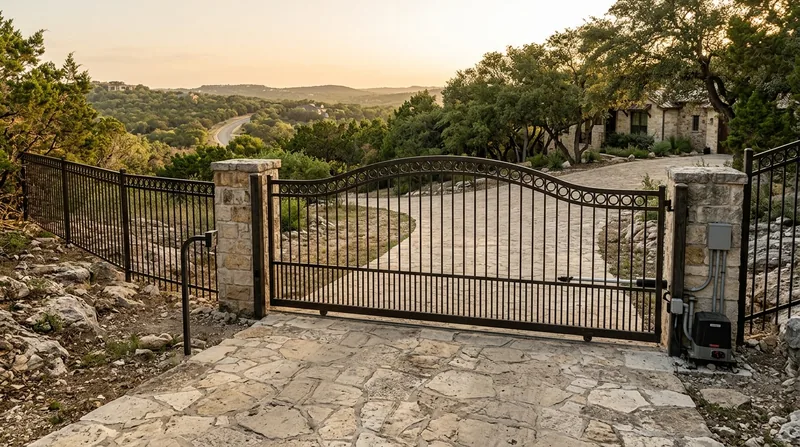




A driveway gate installation in Austin requires engineering that matches the terrain. On the hillside lots west of the Colorado River, posts anchor into drilled limestone bedrock to carry the weight of a swinging or sliding gate and its operator. On the flatter Blackland prairie and clay-heavy soils to the east, we size concrete footings to accommodate the seasonal heave and shrink that defines Greater Austin's expansive clay. Either way, an automatic gate is a precision installation, not a retrofit, and the foundation makes the difference between a gate that operates for two decades and one that binds or fails within five years.
Most homeowners think of a gate as a panel hung on hinges. An automatic gate is an engineered system: a gate operator (the motor and control head), a power source, sensor wiring, and a mounting structure that can withstand daily cycling and the wind loads of a Central Texas storm. When that system is built on a post that heaves or shifts, the gate will bind, the opener will strain, and the hardware will fail. We start with the post, and we build up from there.
Austin Fence Contractors has installed and repaired automatic driveway gates since 2015 across Austin, Round Rock, Cedar Park, Leander, and the surrounding communities. We are AFA Member Installers, fully insured, and we work from a straightforward principle: the gate itself is only as good as what holds it up. Below is what you need to know to make a smart choice.
Why Automatic Driveway Gates Matter on Austin's Variable Terrain
Austin sits on two very different geologies. The Edwards Plateau limestone west of the city creates high, rocky lots where drainage is excellent but post holes demand drilling or blasting. The Blackland prairie to the east rests on clay that swells when wet and shrinks when dry, heaving fence posts and gate frames with seasonal cycles. A driveway gate, unlike a passive fence panel, is a dynamic load. Every opening and closing cycles the hardware, and every wind gust loads the frame. If the post moves, the gate will bind, the operator will burn out, and you will be stuck.
- A swinging gate on shifting posts will bind at the latch and eventually refuse to close.
- A sliding gate on heaved posts will derail from its track or jam against the frame.
- An undersized footing on clay will allow the post to move 1 to 2 inches per season, enough to throw off a gate operator's calibration.
- A limestone post set too shallow will crack or shift under the cantilever load of a heavy sliding gate.
- Gate operators are expensive to replace, and most failures trace back to post movement, not motor wear.
Getting the post right the first time saves thousands in repairs and the frustration of a gate that does not work reliably.
Local example: A homeowner in West Lake Hills installed an automatic sliding gate on a post set in 18 inches of concrete on clay soil. Within two years, the post had heaved 1.5 inches, the gate was derailing from its track, and the opener was cycling the motor trying to close a gate that no longer aligned. We reset the post 4 feet deep with a bell-shaped footing to account for clay movement, and the gate has operated smoothly for five years since.
For more on gate systems and how they integrate with your fence, see our gate installation and repair page.
How We Install Automatic & Driveway Gates: The Process in Austin
Automatic gate installation is a five-step sequence: survey the site, determine the post depth and footing size based on soil and geology, drill or excavate the post hole, set the post in concrete, and then hang and calibrate the gate and operator. We do not cut corners on the foundation, because that is where most gate failures originate. On limestone, we drill deep enough to get below the weathered cap rock into solid stone. On clay, we dig below the seasonal water table and pour a footing with a bell at the base to resist heave.
- We call 811 for a utility locate before any digging, because buried power, gas, and water lines run to most driveways in Austin.
- We measure the driveway width and slope to determine whether a swing gate or sliding gate makes sense for your property.
- We set posts in concrete, not tamped soil, because the weight of an operator and the daily cycling demand a rigid base.
- We install the operator, run the sensor wiring, and test the gate through a full cycle before we consider the job complete.
- We provide you with a manual override key and instructions for emergency operation if power is lost.
The entire process typically takes one to two days, depending on soil conditions and the complexity of the operator setup.
Example from Round Rock: A customer wanted a sliding gate on a driveway with a steep uphill grade and clay soil. We dug the post hole 5 feet deep with a 2-foot bell at the base, set a 6x6 pressure-treated post, and installed a heavy-duty cantilever sliding gate operator. The gate has been in service for three years without binding or settling.
If you already have a gate that needs repair or an operator that has failed, see our fence post repair page for details on how we approach existing installations.
Gate Installation Methods: Swing vs. Sliding
| Gate Type | Description | Best For |
|---|---|---|
| Swing Gate | Hinged on one or both sides, swings open like a door. Requires clearance on both sides of the driveway. | Narrower driveways, flat or gently sloped terrain, properties with room for the gate to swing clear. |
| Sliding Gate | Runs on a track parallel to the driveway, opens to the side. Occupies the same footprint as the opening. | Steep driveways, narrow lots, properties where swing clearance is not available. |
| V-Track Sliding Gate | A heavy-duty variant with the gate suspended from an overhead rail. Common in commercial and estate applications. | Very steep driveways, maximum clearance needs, gates taller than 6 feet or wider than 16 feet. |
| Cantilever Sliding Gate | The gate is anchored at the bottom and extends outward from a single post. No track in the driveway surface. | Driveways where a ground-level track would create a trip hazard or drainage problem. Most common in residential Austin installations. |
Each method has trade-offs in cost, maintenance, and terrain fit. A swing gate costs less to install but needs a solid post on both sides of the opening if you want dual-swing operation. A sliding gate costs more upfront but takes up no driveway space and works on steeper slopes. We assess your driveway grade, width, and soil type to recommend the method that will work longest without repair.
Automatic & Driveway Gates Cost in Austin: What to Expect
An automatic driveway gate installation in Austin starts at $3,200 for a basic swing gate with a single operator on stable soil. That baseline covers the post, concrete footing, gate frame, hinges, a residential-grade operator, and basic wiring. From there, cost climbs based on real site conditions: soil type, driveway width, gate material, and operator features.
On clay soil, expect to budget an extra 15 to 25 percent for deeper footings and reinforced concrete work. On limestone, drilling costs more than digging, but the post typically sits shallower. A sliding gate costs 20 to 40 percent more than a swing gate because the track, rollers, and cantilever post demand heavier materials. A dual-swing gate (opening both directions) requires two operators and costs roughly double a single-swing installation. Ornamental iron gates, wood gates, and vinyl gates vary in material cost but do not change the operator or footing price significantly.
Factors that move the estimate up include:
- Driveway width greater than 16 feet, which requires a heavier gate frame and stronger operator.
- Steep grade (more than 15 degrees), which may require V-track or cantilever sliding installation instead of swing.
- Limestone bedrock, which requires drilling instead of digging and may need a blasting permit.
- Proximity to utilities, which may require hand-digging or directional boring to avoid buried lines.
- Gate material choice, from basic chain link to ornamental iron or wood, which affects frame weight and structural requirements.
- Advanced operators with keypads, intercom, or smartphone control, which add $500 to $1,500 to the job.
The best way to get an accurate price is a free on-site estimate. Call (737) 237-0592 or visit our pricing page for more detail on what moves the cost for your specific property.
Automatic & Driveway Gates Near Me: What Austin Homeowners Should Know When Hiring
Finding a reliable contractor for an automatic gate installation is not the same as hiring a fence builder. A gate is a mechanical system, and the installer must understand post engineering, electrical wiring, and operator calibration. Here is what to look for when you are comparing estimates in Austin, Cedar Park, Leander, or any of our service areas.
Insurance and liability coverage matter more for gate work than for passive fencing. Gate operators carry electrical risk, and if something fails, you need to know the contractor can cover the damage. We are fully insured with general liability and workers' compensation, and we can provide a certificate of insurance on request.
Fence licensing in Texas is set by county, not by state. Texas issues no statewide license for fence installation, so claims of state licensure are meaningless. Some counties require a licensed general contractor for jobs above a certain value, typically $40,000 or more. Check with the Austin building department or your county clerk to confirm the threshold for your jurisdiction. We work within all local permitting requirements and can advise you on whether a permit is needed for your gate.
Permits and setback rules vary by city and HOA. Some jurisdictions require a permit for an automatic gate; others do not. Many master-planned communities in Austin impose height, material, and color restrictions that apply to gates as much as fences. Before you commit to a design, check with your HOA and the local building department. We can help you navigate those rules and point you toward the right office to call.
Get multiple estimates and ask each contractor how deep they will set the post and why. If two contractors give wildly different answers, ask them to explain their reasoning. A contractor who digs 3 feet on clay and another who digs 5 feet are not both right, and the difference will show up in gate performance within two years.
Ask for references from gates installed in the last three years, especially on clay soil or steep terrain similar to your property. A gate that has been working smoothly for three years is proof of good post work.
For a free estimate and to discuss your specific property, contact us online or call (737) 237-0592. We respond within 24 hours and will walk you through the options for your driveway.
Automatic & Driveway Gates in Austin: Pricing Guide
| Service | Price | Details |
|---|---|---|
| Basic Swing Gate Installation | Starting at $3,200 | Single swing gate, residential operator, post set in concrete footing, basic wiring, stable soil |
| Sliding or Cantilever Gate Installation | Starting at $4,500 | Track or cantilever system, heavier-duty operator, reinforced post, suitable for slopes or narrow lots |
| Dual-Swing or Advanced Operator System | Starting at $6,200 | Dual-swing gate opening both directions, or single gate with smart controls, keypads, intercom, or smartphone access |
| Clay Soil or Limestone Drilling Adjustment | Add 15 to 40 percent | Deep footing work on expansive clay, or drilling into limestone bedrock instead of digging soil |
| Estimate and Site Visit | Free | No obligation, response within 24 hours, includes soil assessment and operator recommendation |
Indicative pricing, the exact cost depends on square footage, finish, and site access. Free personalized estimate within 24h at (737) 237-0592.


